On 5th April 1848, at the Red Lion, Turners Hill, an auction took place which was to be significant in the growth and development of the village of Crawley Down. That afternoon, at two o’clock, twelve parcels of land went under the hammer. Ten of them were sold for around £35 per acre; among them being all the land along the Turners Hill road between Sandy Lane and Vicarage Road, with the exception of the part where the school was subsequently to be built. Most notable at the time, however, must have been the sale of the remaining two lots, of about one and a half acres apiece, along the same side of the road, but to the south of Vicarage Road. In what was rather euphemistically described at the time as ‘a spirit of opposition’ these two lots were sold to John Hewetson Wilson and Charles Milligan, respectively, for £160 and £162; an average price of more than £100 an acre! History does not bequeath to us the background to this ‘spirit of opposition’ but it was to have prolonged consequences.
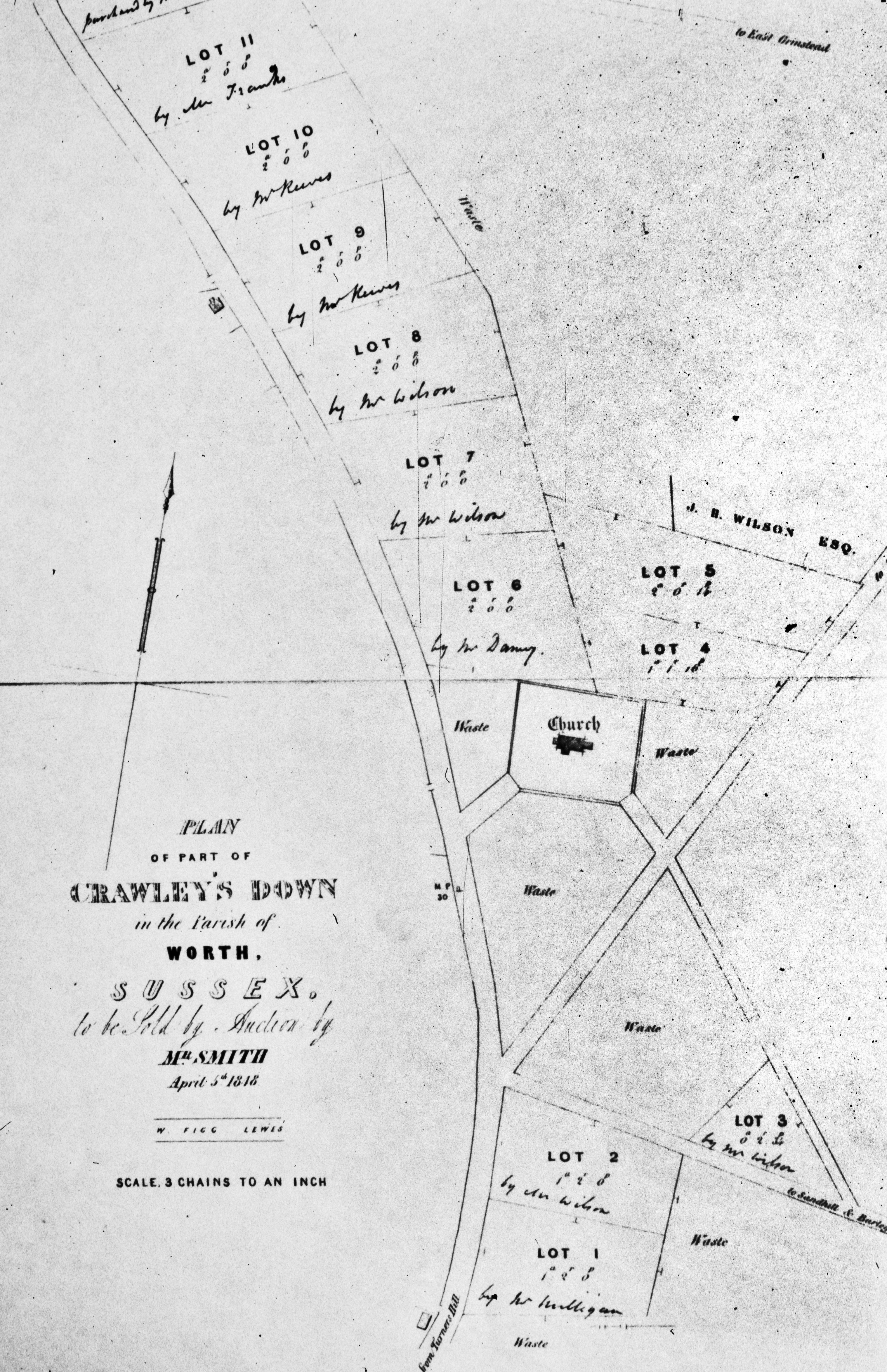
Mr Milligan promptly built what is now Bankton Lodge on his plot, as an entrance lodge for his house sited where Bankton was to be built some fifteen years later (see The House before Bankton). Mr Wilson did nothing. He was later to claim that it had been his intention to do the same as Milligan, and to build a lodge for his own home, the Grange, but that his plans were delayed by the death of his only surviving son James, a promising young botanist, at the early age of 23.
What had clearly not perturbed Wilson was that plans, for a railway to cut through his newly acquired piece of land had been in existence since the passing, in 1846, of the first East Grinstead Railway Act. That Act was presumably expected to expire for lack of progress, as indeed it did. But what Wilson did not bargain for was the resurrection of those plans, to build a railway from Three Bridges to East Grinstead, so soon after the failure of the earlier attempt.
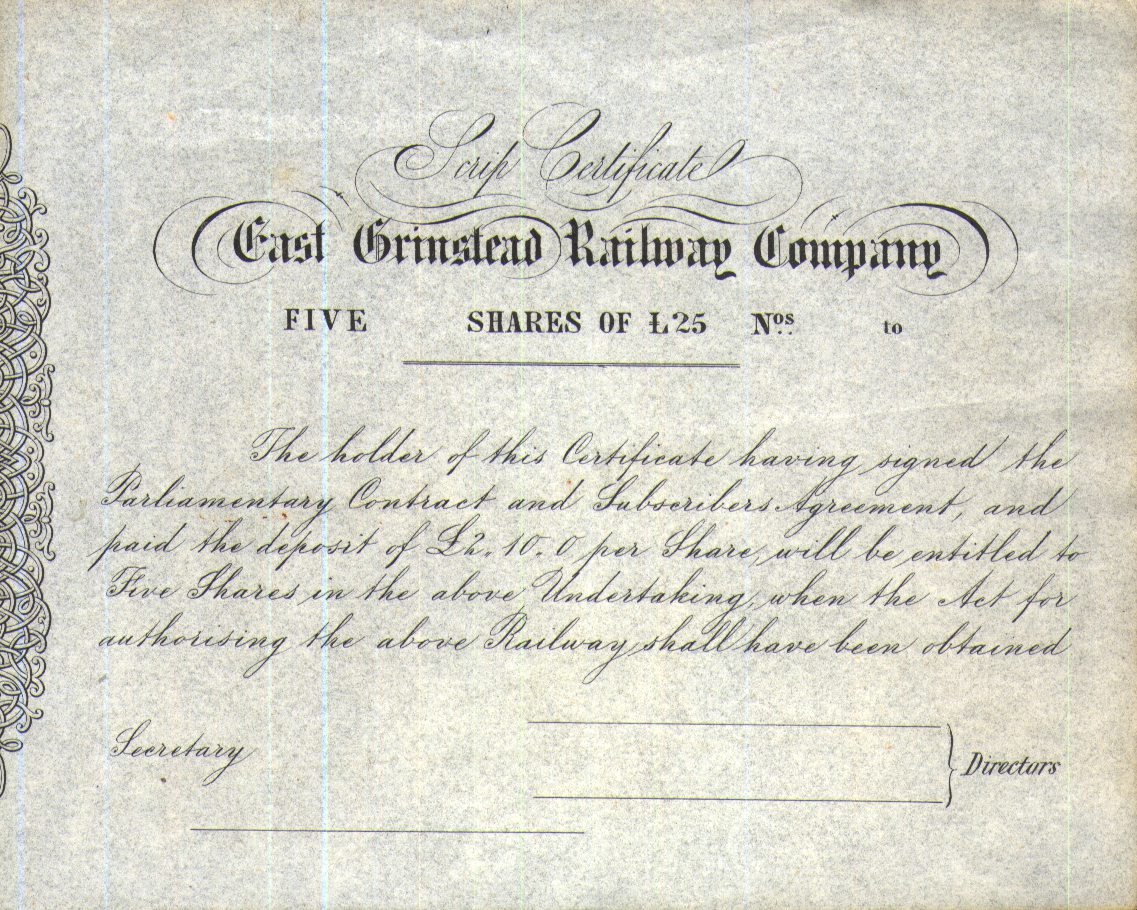
Using the 1846 plans, slightly modified, the East Grinstead Railway Company was formed in the summer of 1852 and Mr Wilson, as a landowner on the route, was duly notified. In a remarkably short time, a contractor was chosen and his estimate of £47,000 agreed. Wilson, however, had already made his objections known, and the Company, and officials from the London, Brighton and South Coast Railway, who were in charge of the project, made every effort to accommodate him. Mr Jacomb Hood, the Chief Engineer, drew up a plan for a tunnel under Crawley Down, largely avoiding Wilson’s land, but Mr. Wythes, the Reigate-based contractor, objected. Wilson suggested a re-routing further north, but this would have entailed a much wider bridge to take the Vicarage Road-Turners Hill Road junction, and it would have made the curve there too sharp for the station they had proposed for Crawley Down. Despite this the suggestion was seriously considered by the Company, as delay was proving embarrassing. Wilson continued to object, as the railway would still pass through the land for which he had paid so much. He employed an engineer, a Mr. Brindley, to draw up an alternative plan, going back to the idea of a wider road bridge and introducing the idea of a goods yard on Wilson’s land. This was rejected by the Company as, in the meantime, they had come to an agreement with Sir Curtis Lampson to build a station at Rowfant, and therefore the cost of a station at Crawley Down was now out of the question.
By the summer of 1853, the second East Grinstead Railway Act had been passed and Wilson had been served with the equivalent of a compulsory purchase order. Time was running out. Work had started on the line and still Wilson ‘dug in his heels’. It should be pointed out at this stage that Wilson had no objection to the railway passing through the thirteen acres he owned on the west of the main road, or indeed to any land other than the precious acre and a half his ‘spirit of opposition’ had cost him. William Peerless, the Company’s Secretary, observed to Wilson that a cutting would be better than an embankment, but such was Wilson’s mood that he said he would have preferred an embankment! By 1854, the matter had gone to arbitration.
Charles Marchant, the surveyor appointed by the magistrates, valued all the four and a half acres which Wilson would lose to the railway at £524. Wilson claimed a staggering £5448 17s 6d. Despite the various plans and counterplans which had been put forward by the railway company and by Wilson, there had been no agreement and, even before the case had gone to arbitration, the Company had taken possession of the piece of land which had been at the root of the problem, and had paid into the Bank of England the £524. It therefore remained for Wilson to exact what reparation he could for his loss.
Mr Wilson rested his case heavily on the damage the railway would do to his land. He claimed that it was affecting the drainage, a fact refuted by local people. He claimed that valuable building stone was being removed, but Wilson’s near neighbour, Benjamin Chandler, a stone mason, testified that local stone was of indifferent quality and that there was little demand. And Wilson claimed that the water level in an ornamental fish, pond (now the lake in the grounds of Bankton) had been affected. but it was pointed out by the Company that, until about five years before, this had been a parish gravel pit and generally dry in the summer months. All in all, Wilson’s claims were seen as unreasonable and, bearing in mind that his objections almost entirely hinged on the particular piece of land he had paid so dearly for, his claim was not met. Nevertheless, the Board of Trade assessor, Mr. Powell, allowed Wilson £1400 which, although a high price, the Company felt bound to accept with relief as the opening of the line was, by then, less than six months away, in July 1855.
Mr Wilson did manage to salvage some credit from the controversy. Another effect of the excavation of the cutting beneath the Turners Hill Road was the disappearance of a public open space upon which the people of the neighbourhood had been able to play cricket or football. As compensation for the loss, in 1857 Mr Wilson acquired a piece of land from Sir Percy Shelley and made it available for public use. Thus the cricket field in Sandy Lane come into being. It was originally intended that it would be placed in the hands of trustees in perpetuity but that never happened, though eventually Mr Wilson’s great-great niece, Miss Louisa Buckley, gave it to the Parish Council in the 1930s.
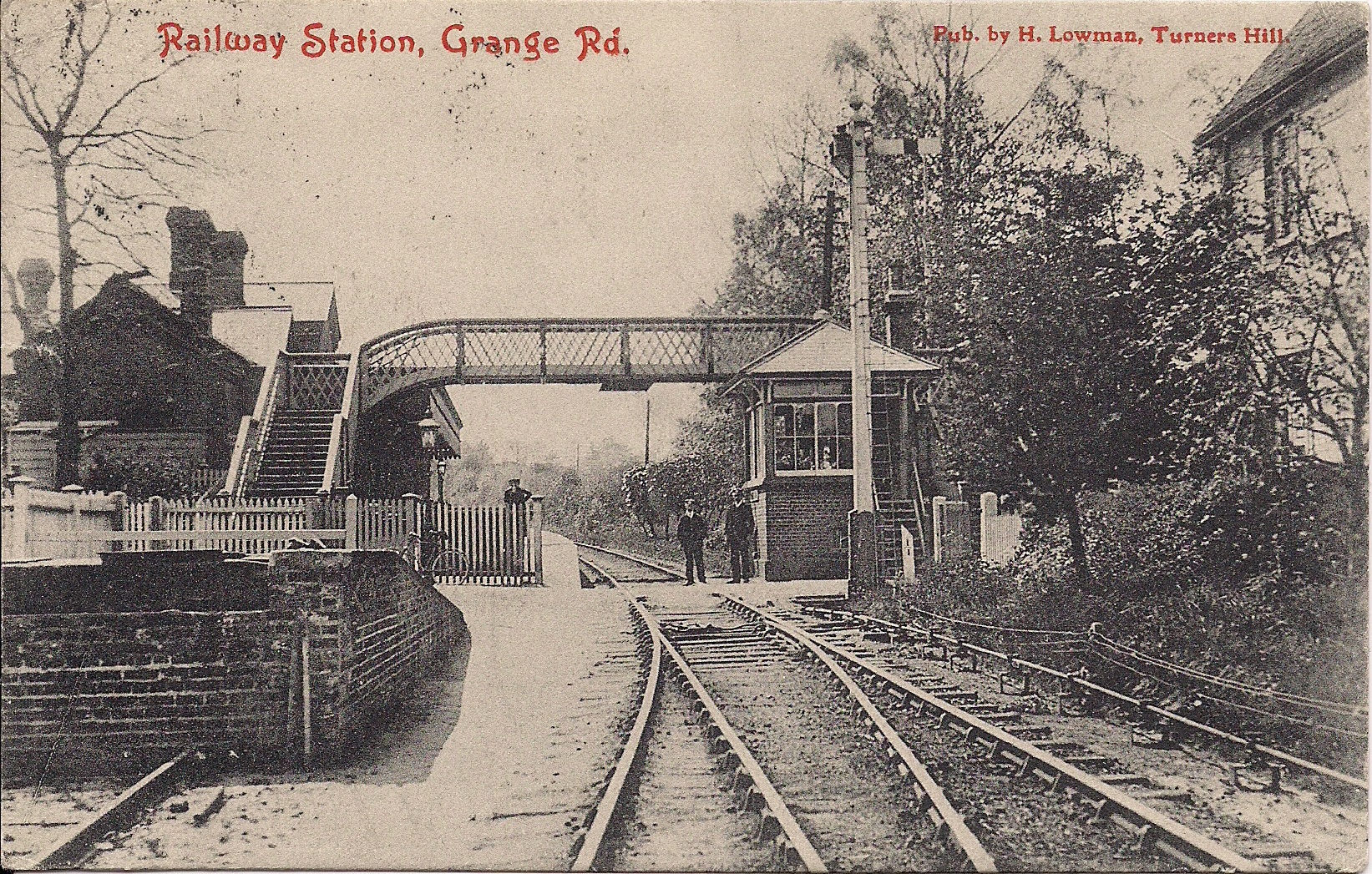
Crawley Down did, of course, get its station in 1860, but it was further east than it was originally proposed, and it was built, ironically, with the encouragement of Mr Wilson’s nephew, Richard Wilson Buckley, who in 1862 was to inherit the Grange estate. The line, and Grange Road Station as it was to be called, remained open until January 1967.