
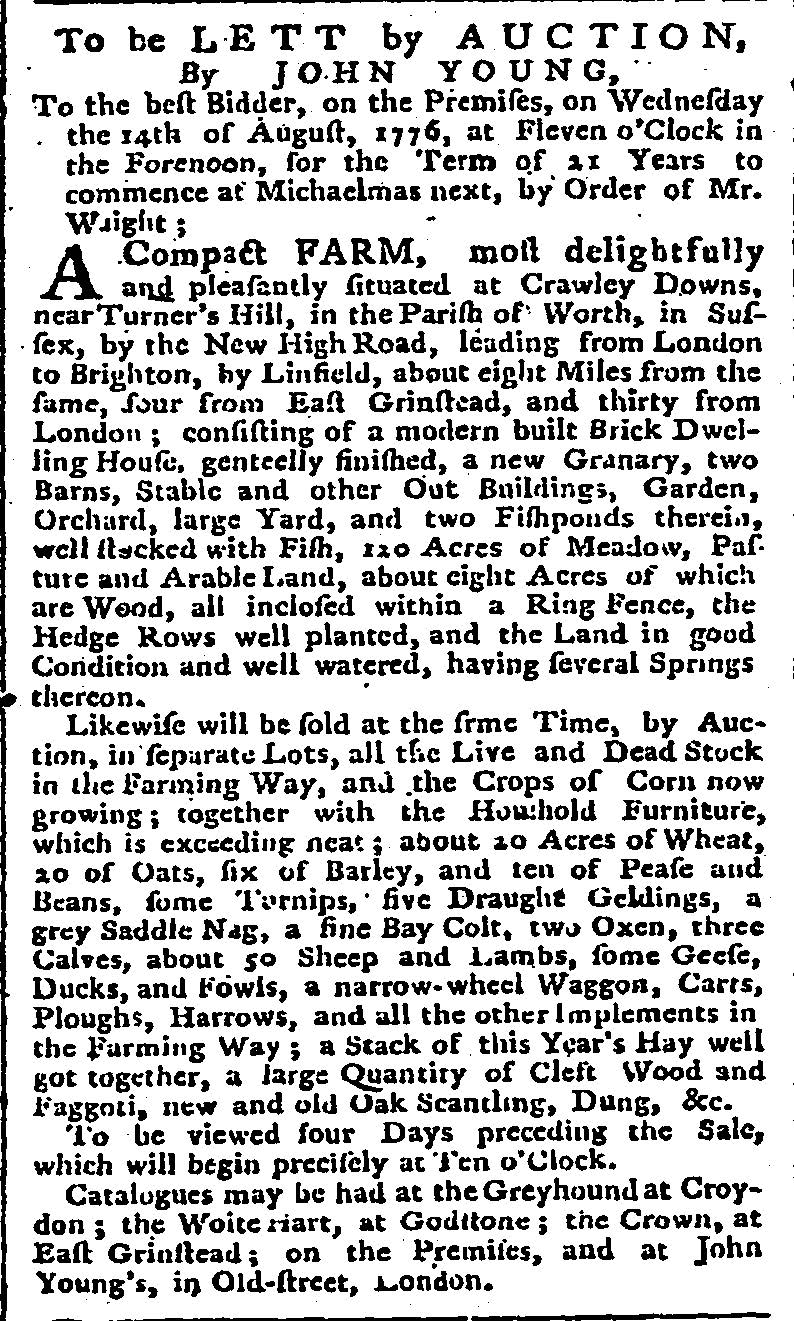
It is not known exactly when The Grange was built. Up to 1738 it is referred to in the records as two properties: the Chequer, formerly known as Shadburns, which sounds as though it might have been an inn (indeed one record indicates that it had a sign); and Clarkes, which when Richard Michelborne died in 1583, was described as a manor or ‘capital messuage’. The next time we hear of it is in 1776 when this advertisement appeared in a London newspaper. By then the Chequer had been replaced and Clarkes Farm had been incorporated into a new estate.
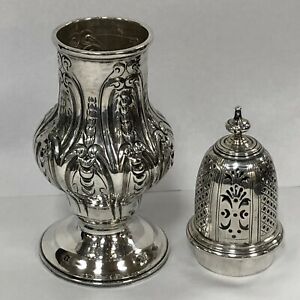
It was being advertised to let by a Mr Wright who, when he mortgaged the property two years later, was described as Charles Wright, silversmith, of Ave Maria Lane in the City of London. He had been working at that address since 1757 in partnership with a Thomas Whipham, to whom he had earlier been apprenticed. In 1775 Whipham retired so Charles Wright carried on as sole proprietor for nine years until he moved his premises to The Strand and then merged his business with fellow silversmiths, Thomas and Henry Chawner. He was a fine silversmith and surviving pieces by him fetch high prices in the present day.
Charles Wright put The Grange up for sale in 1788, two years short of when he seems to have retired, and the sitting tenant was named as a David Knox. Knox may have been tenant for a few years for he had been married at Worth church in 1784. But he attracts our attention in relation to a rather bizarre set of circumstances. In the 1787 edition of a short book extolling the virtues of a styptic, a treatment used to stem the flow of blood, a letter from a Dr Thomas Young of East Grinstead was quoted. In it he described the shocking instance when a blood vessel in a patient of his burst suddenly and how almost certain death was averted by the application of this styptic which had been formulated by the then celebrated ‘surgeon-dentist to the Prince of Wales’ Bartholomew Ruspini. The patient was none other than David Knox. If you want to read the full account, it is a somewhat gory tale.
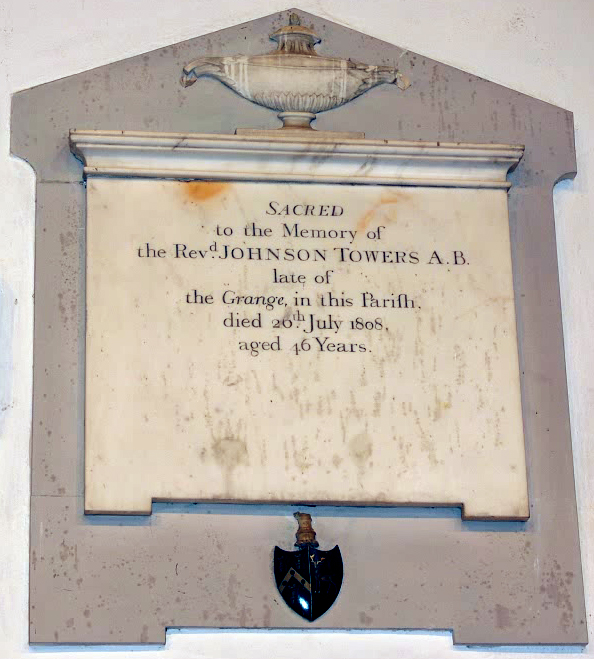
The Grange was sold in 1789 and David Knox moved to Charlwood, where he died in 1793. The new owner was the Reverend Johnson Towers whose father had been the headmaster of Tonbridge School. Towers had been a curate at Leatherhead but does not appear to have had ‘cure of souls’ as they used to say. He was only 27 when he purchased The Grange and appears to have lived off the income from the estates his father left him. A memorial in Worth church records his death at the young age of 46, after which his widow, Elizabeth, sold The Grange and its farm for £7068 18s 0d in 1809.
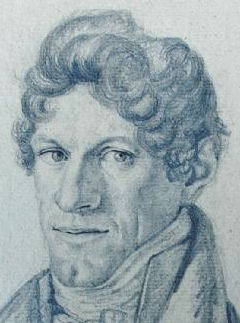
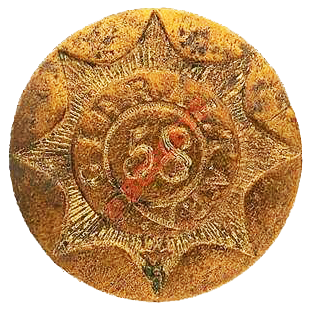
Henry Hewetson, who was the purchaser, was unlike Johnson Towers and more like Charles Wright in his background. He was a laceman, that is a manufacturer of gold lace. He was in a very lucrative business at that time for the United Kingdom had been at war with France since 1792 and the huge demand for military uniforms and their gold accoutrements such as buttons, epaulettes and aiguillettes meant that a great deal of business and money came his way. He and his uncle Richard Hewetson, who he joined in business in King Street, Covent Garden, were successively Gold-lacemen to the king, George III, earning Henry the nickname ‘Gold-lace Harry’. He amassed a considerable fortune and when he died, unmarried, in 1838 bequests from his will amounted to about £500,000 (nearly £57 million in today’s money), which was divided between his 16 nephews and nieces. The Grange was left to John Hewetson Wilson, the son of his sister Isabella, and from then on for nearly a hundred years ownership of the property descended by inheritance rather than purchase.